
Access Management
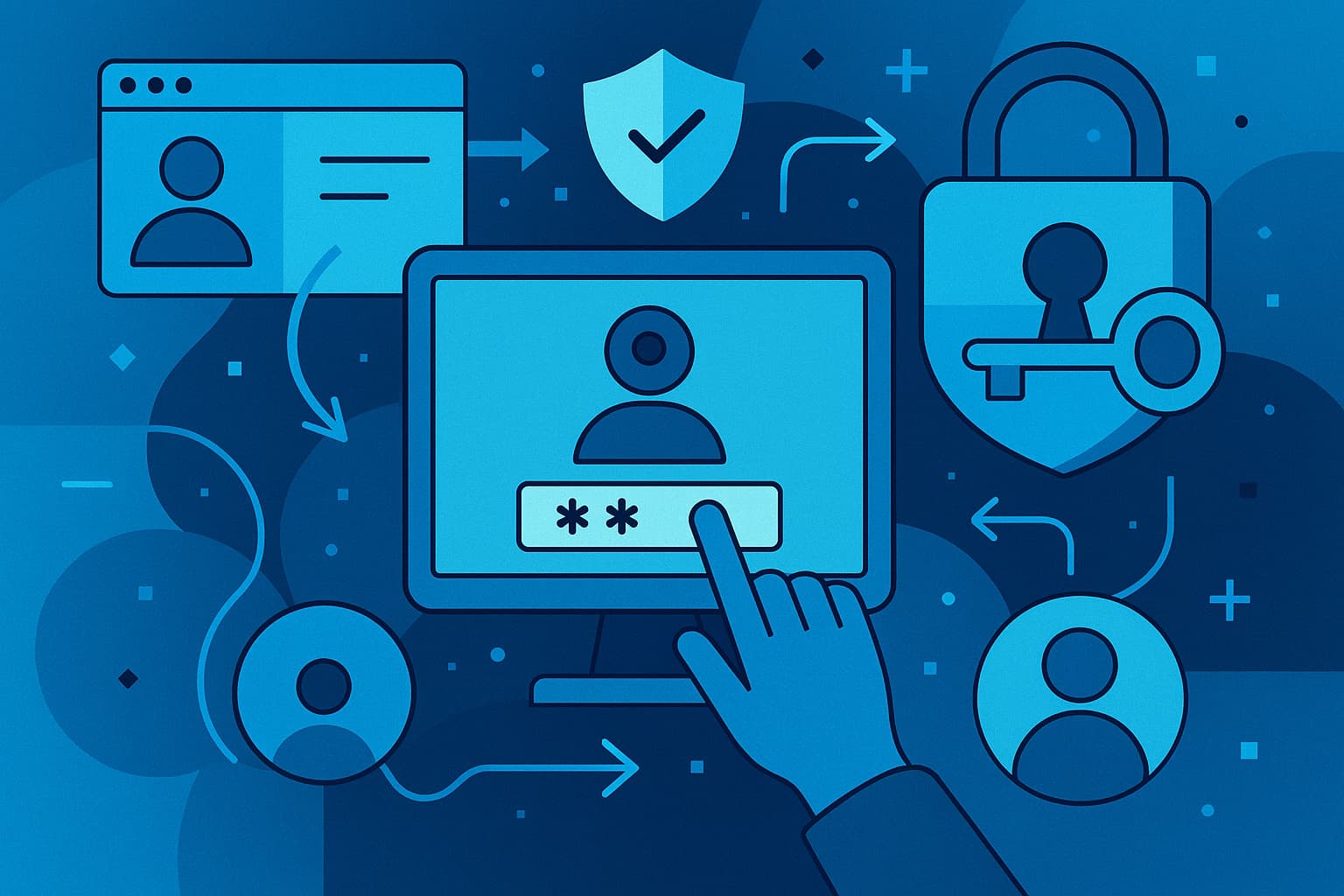
Access Management is the runtime layer of IAM: it decides who can sign in, how they prove it, and what they can do once they’re in. It includes authentication (login), authorization (permissions), and session management (tokens/cookies, refresh, logout, and step-up).
Access Management
Access Management is the runtime layer of IAM: it decides who can sign in, how they prove it, and what they can do once they’re in. It includes authentication (login), authorization (permissions), and session management (tokens/cookies, refresh, logout, and step-up).
Single Sign-On (SSO)
Enable users to access multiple applications with one set of credentials.
Multi-Factor Authentication
Add additional verification factors beyond passwords for stronger security.
OAuth 2.0 and OIDC
Implement modern authorization and authentication protocols for APIs and applications.
Federation and Trust
Establish identity federation between organizations for seamless access.
Session Management
Control user sessions including timeouts, concurrent sessions, and secure logout.
Adaptive Authentication
Implement risk-based authentication that adjusts security based on context.
Passwordless Authentication
Implement modern authentication methods that eliminate password vulnerabilities.
API Security
Secure APIs with proper authentication, authorization, and rate limiting.
Authorization Models
Understand RBAC, ABAC, ReBAC, and other authorization approaches.
Access Gateway and Proxy
Deploy reverse proxies and gateways for centralized access control.
Cloud Identity and Access Management (Cloud IAM)
Cloud Identity and Access Management IAM , often referred to as Identity as a Service IDaaS , represents a paradigm shift in how organizations manage user identities and...
FIDO2 (WebAuthn / CTAP)
FIDO2 Fast Identity Online is an open authentication standard developed by the FIDO Alliance and W3C that enables passwordless authentication through public key cryptography....
Identity Orchestration
Identity Orchestration is an enterprise software control layer that unifies and coordinates identity and access management IAM systems across cloud, on-premises, legacy, and...
OAuth 2.0 Step Up Authentication Challenge
The OAuth 2.0 Step Up Authentication Challenge Protocol is a mechanism that OAuth 2.0 /access-management/oauth2 resource servers can use to signal to a client that the...
OAuth 2.1
OAuth 2.1 is an authorization framework that enables secure and delegated access to protected resources on behalf of a resource owner. It provides a standardized protocol for...
OpenID Connect (OIDC)
OpenID Connect OIDC is an authentication protocol built on top of OAuth 2.1 /access-management/oauth2 , adding standardized identity verification to OAuth's authorization...
FIDO2 Passkeys
FIDO Passkeys are a modern passwordless authentication standard based on FIDO2 /access-management/fido technology. They replace traditional passwords with cryptographic...
Third-Party Identity
Third-Party Identity, also known as Federated Identity or Social Login , refers to the use of external identity providers IdPs to manage user identities and authentication for...
OAuth 2.0 DPoP
OAuth 2.0 Demonstrating Proof of Possession DPoP is an extension to the OAuth 2.0 /access-management/oauth2 protocol that provides a mechanism for cryptographically binding...
OpenID AuthZEN / P*P
OpenID AuthZEN Authorization Exchange standardizes the API boundary between Policy Enforcement Points PEPs and Policy Decision Points PDPs , enabling applications and API...
Shared Signaling Framework (SSF)
The OpenID Shared Signaling Framework SSF , previously known as Shared Signals and Events Framework, is a standardized framework that enables real-time sharing of security...
Grant Negotiation and Authorization Protocol (GNAP)
The Grant Negotiation and Authorization Protocol GNAP is an emerging authorization and authentication protocol. The GNAP specification effectively consolidates all the...
LDAP
Lightweight Directory Access Protocol LDAP LDAP, or Lightweight Directory Access Protocol, has historically been the backbone of enterprise identity management, providing a...
SAML 2.0
In the ever-evolving landscape of digital identity and authentication, organizations are constantly seeking robust and standardized solutions to secure access to their systems...
Passkeys at Scale: Rollout Strategy, Recovery, and Policy
Phasing in passkeys across an enterprise: recovery, exceptions, and policy guardrails.
Session Management in Modern IAM
Token lifetimes, refresh strategies, logout reality, and revocation patterns.